.png)


What is Social Media Advertising? How to use SMA for business.
- Kevin Vejo

- May 19, 2020
- 3 min read
Updated: Nov 9, 2020
Social media advertising is the process of targeting your buyer personas, audience, and customers and promoting your brand, product or service via social media post and ads to convert leads and increase revenue. (Hubspot 2020)
As stated in the following graphic, half of the world population is active on social media.

Social media and advertising are two components used together to target the potential clients on social media platforms, such as Facebook, Instagram, Twitter, LinkedIn, Tik Tok etc…
One of the many benefits that SMA offers is a very cost-effective ROI (Return on Investment), but choosing the right platform is key for a good and successful advertising strategy.
Social Media platforms offer you targeting options such as age, gender, location, interests, behaviours, educational background, relationship status etc… Therefore, allowing your business to target the people that best fit the needs and attributes of your product/service.
Each platform has different audiences and targeting options, for example:
71% of Pinterest users are females (Statista, 2020) between 24-54 years old (SproutSocial 2020), therefore if your product/services are more dedicated to males you will not do advertising on Pinterest.
Also, not all social media platforms offer the same targeting options so you must research which platform is more accurate to your target audience and offers you the most useful targeting options.
Let’s review some of the most important Social Media Platforms aspects for advertising and their demographics:
Facebook: offers the greatest wealth of targeting options of any social advertising platform such as age, location, gender, interests, behaviours, educational background, relationship status, previous interaction with your website…
In addition, you can install the Facebook Pixel plugin on your website which tracks your visitor’s information and allows you to target them on Facebook.


Facebook usage among key demographics, by SproutSocial 2020
Instagram: Instagram Ads is fully integrated with Facebook Ads, so you get the benefits of Facebook’s superior campaign customization options, diverse formatting, and assorted targeting capabilities combines with Instagram’s high engagement. According to Yotpo (2018), Instagram users are 58x more likely to engage with branded content on Instagram than on Facebook, and 120x more likely to engage on Instagram than Twitter.

Instagram usage among key demographics, by SproutSocial 2020
Youtube: YouTube advertising has a key role to play in gaining awareness and competitive advantage offering the ability to advertise on competitor channels and the channels and ad roll of videos which relate to interests or topics specific to your offering or target audience.
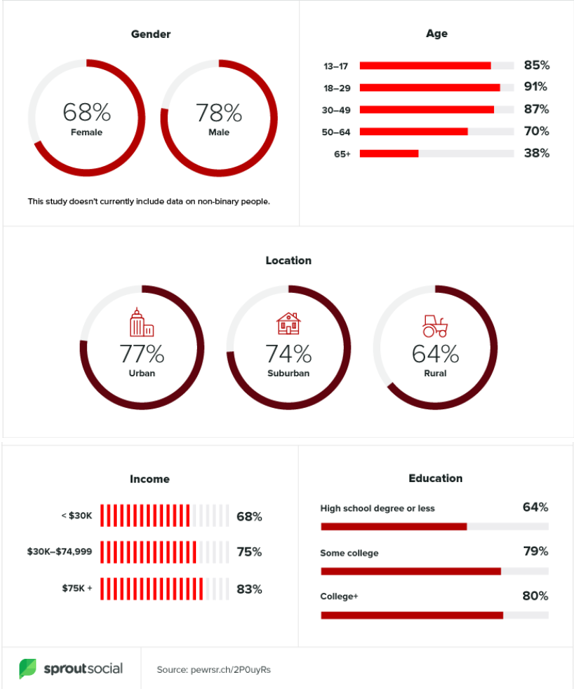
Youtube usage among demographics, by SproutSocial 2020
When analysing Social Media Advertising we need to set first goals and metrics of how we are going to measure, here are some examples of goals and KPI’s;
Increase Brand Awareness:
KPI’s for brand awareness campaigns: Reach of your ads, increase of engagement, mentions and followers and secondary but not less important, leads and conversions.
Sales and Conversions:
KPI’s for Sales and Conversions campaigns: Number of Clicks, sales and leads and the cost of those clicks and leads against the media spend on social media advertising. Vanity metrics which are not direct or solid indicators of improved public perceptions are not considered as relevant.
Building a community:
It is important to analyse the level of follows, likes, retweets, and shares as well as negative reactions and comments in order to grow a healthy and engaged community.
Research into the Target Market:
When campaigns aim at aiding research and development, the comments or poll results contributed, and the demographics are your most relevant insights and metrics.
SOURCING:


Great post